The Old Fire House sits at the corner of Cleveland Street and Redmond Way, a squat brick building that has served Redmond's teenagers since 1952, back when the city was still a berry-farming town on the eastern shore of Lake Washington. Seventy-five volunteers built it. Three generations of kids grew up inside it.
On March 11, 2025, the City of Redmond announced it was shutting it down. The community had less than three weeks' notice. Within a weekend, 2,104 people had signed a petition to save it.
They didn't know that the decision had already been made — two years earlier, behind closed doors. They didn't know that the building had been deliberately starved of maintenance funds for six years. They didn't know that the developers who stood to profit from the cleared land were the same people who funded the mayor's campaigns and sat beside her on a powerful business coalition board.
And they couldn't have known — because when a citizen filed a public records request to find out how the decision was made, the City of Redmond's response, even after expanding to seven installments, left the outgoing emails of four named officials at the center of the decision entirely absent, collapsed the month of December 2024 to a handful of automated records in a period of documented heavy activity, produced no substantive record of any OFH-related council session, stakeholder meeting, or property negotiation after March 30, 2025, and contained zero mentions of the predecessor city whose rejection of the Plymouth Housing deal sent it to Redmond.
This is the story of how it happened.
The Teacher Becomes the Mayor
Angela Birney was a middle school science teacher before she entered politics. She won a seat on the Redmond City Council in 2015, became Council President in 2018, and ran for mayor in 2019 with a simple promise: "I will ensure a high level of integrity among everyone at city hall."
She outspent her opponent, fellow council member Steve Fields, four to one. Her $105,000 campaign war chest came overwhelmingly from one sector: real estate developers.
The single largest donor bloc was the Nelson Legacy Group, a Redmond development firm that had been building in the city since the 1950s — now in its third generation under CEO Tim Overland and heir Mary Nelson Morrow. NLG and its affiliates gave Birney more than $21,000 across her campaigns. They owned 22 contiguous acres in downtown Redmond.
Those 22 acres sit directly adjacent to the Old Fire House.
Contributions
Developers
Group Alone
Her Opponent
The Board Where Deals Are Made
To understand what happened in Redmond, you have to understand OneRedmond.
OneRedmond is a 501(c)(6) business league — essentially a chamber of commerce with a more sophisticated name. It operates on an annual budget of about $1.3 million, funded by corporate sponsors. Its highest sponsorship tier, "Founder Investor," is occupied by one company: Nelson Legacy Group.
The board reads like a conspiracy theorist's corkboard come to life — except it's all public, posted on the organization's own website:
| Name | Board Role | Employer | Conflict |
|---|---|---|---|
| Steve Yoon | Chairman | Mill Creek Residential | Developer — 1,610+ luxury units in Redmond |
| Tim Overland | Secretary | Nelson Legacy Group (CEO) | Mayor's largest donor — NLG seat #1 |
| Amy Webber | Member | Nelson Legacy Group | NLG seat #2 |
| Katie Kendall | Member | McCullough Hill PLLC | Land use law firm — gets developers their permits |
| Ken Nelson | Member | Davis Wright Tremaine | Land use attorney — same surname as NLG family |
| Vanessa Kritzer | Member | City of Redmond Council | Sitting council member |
| Angela Birney | At-Large | City of Redmond (Mayor) | THE MAYOR — votes them contracts |
| Michael Mattmiller | Past President | Microsoft | |
| Keri Pravitz | Member | Amazon |
There is also a Government Affairs Committee — the body where policy is actually shaped. Its chair is Tom Markl, Nelson Legacy Group's CEO (and a $2,000 donor to Birney — double the legal contribution limit). Sitting alongside him: Carol Helland, the city's Planning and Community Development Director, who approves the building permits that developers need. And Amy Tsai, the mayor's own Chief Policy Advisor.
In the six years since Birney took office, she has never once recused herself from a vote involving companies whose executives sit on this board.
Follow the Money
Over three campaigns, Birney raised $227,013. The money tells the story:
| Donor Category | Total | Share |
|---|---|---|
| Nelson Legacy Group (8+ individuals) | $21,675 | 9.5% |
| Real estate/development industry | $42,621 | 18.8% |
| OneRedmond board members & companies | $32,405 | 14.3% |
| McCullough Hill PLLC (land use attorneys) | $2,550 | 1.1% |
The people who fund her campaigns sit on the board she sits on, and she votes them city contracts — $300,000 to OneRedmond in February 2023, another $300,000 in March 2025, both on the consent agenda, both unanimous, both without competitive bidding, and both without the mayor recusing herself.
In 2019, at least ten donors exceeded the legal contribution limit of $1,000. Tom Markl gave $2,000. Stephen Hansen of JSH Properties gave $2,000. The Washington Association of Realtors PAC gave $2,000. Total excess: approximately $6,815.
The Public Disclosure Commission took no action.
The Land Giveaway Nobody Saw
In early 2024, the city of Kenmore — a small community on the north shore of Lake Washington — held three public hearings and a nine-hour council meeting about a proposed 120-unit supportive housing project by Plymouth Housing Group, a Seattle-based nonprofit with $321 million in assets. On January 22, 2024, the Kenmore City Council voted 6-1 to reject it.
Twenty-two days later, the City of Redmond approved the same project.
There were no public hearings. No request for proposals. No competitive bidding. No public comment period before the vote. The city committed $5.5 million in assessed land value — given to Plymouth Housing for free — plus an additional $3.2 million in cash.
- January 22, 2024 Kenmore City Council votes 6-1 to reject Plymouth Housing project after three public hearings and a nine-hour meeting
- February 13, 2024 City of Redmond approves the same project. 22 days. Zero hearings.
- April 2, 2024 Plymouth's attorney emails city counsel: "I decided it was just easier to propose a transfer option agreement."
- April 16, 2024 Carol Helland presents to council at 4:30 PM. Mayor Birney signs the same day. Fourteen days from proposal to signature.
A citizen named Linda Cole-Weaver saw it happening. On March 24, 2025, she wrote to the City Council: "You got away with selling the Cleveland property to Plymouth Housing because no one was watching. The citizens are aware of your agenda and we will be watching."
Her email was duplicated 35 times in the city's public records production. Padding.
Starving the Old Fire House
The closure of the Old Fire House did not happen suddenly. It was engineered over six years through a simple mechanism: deny the building money, let it deteriorate, then cite the deterioration as justification for closure.
Between 2017 and 2023, OFH staff submitted $94,370 in capital equipment requests. Stage lighting with electrical faults. ADA compliance upgrades. Safety hazards. All denied.
The building's revenue targets were set at $106,271. Actual revenue: $6,129 — a capture rate of 5.8%. The gap wasn't incompetence. It was policy. A building that can't raise revenue can't justify its existence.
All Denied
Rate
Before Public Told
First Weekend
By January 2023 — more than two years before the public would learn anything — "Alternate Facilities Plan" appeared in internal team agendas. The closure was already decided.
On July 31, 2024, an internal email from staff member Erica Chua informed 16 colleagues that the OFH would become a "satellite site." The public would not learn this for another eight months.
On November 14, 2024, the city hired Stepherson & Associates, a PR firm, at $4,468.75 per month. That monthly PR bill exceeded the building's monthly maintenance costs of $3,083.
The Announcement Machine
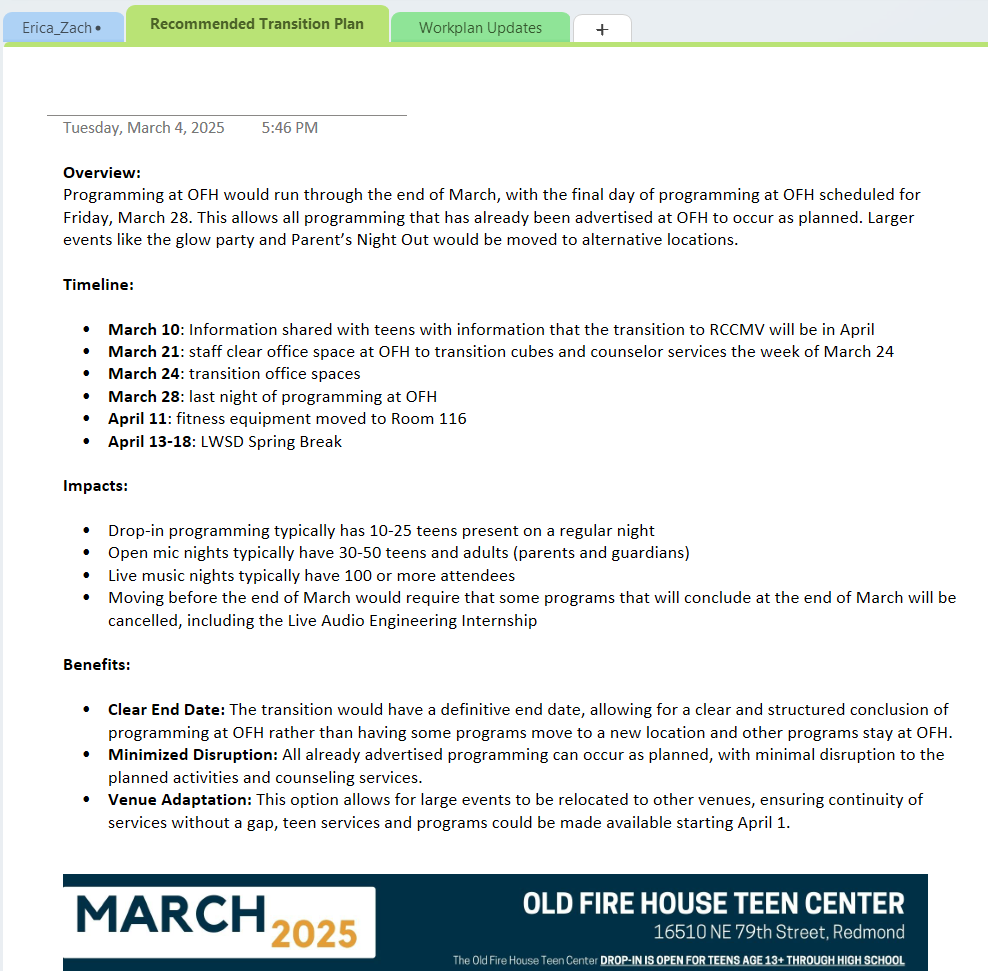
The public announcement came March 11, 2025. But the machine had been running for months.
Emails recovered from the city's own records production reveal the apparatus:
Internal Communications — Reconstructed from PRA Production
- Malisa Files (city staff) to Lisa Maher: "Could you work with Loreen to work on talking points for the Mayor"
- Brant DeLarme to staff: "rewriting the talking points with the Mayor's feedback"
- DeLarme to Maher: "PDF of all embargoed materials for tomorrow AM"
- Zach Houvener: "the Talking Points document is internal only and not meant to be public facing"
The talking points themselves? Repeatedly referenced in the body text of produced emails. Whether the actual documents are present inside the .msg containers is something the city will not let the public verify — no exemption log, no privilege log, no itemized index of what was withheld and why. Under RCW 42.56.210(3), that log is not optional. The city has not produced one for any of the seven installments.
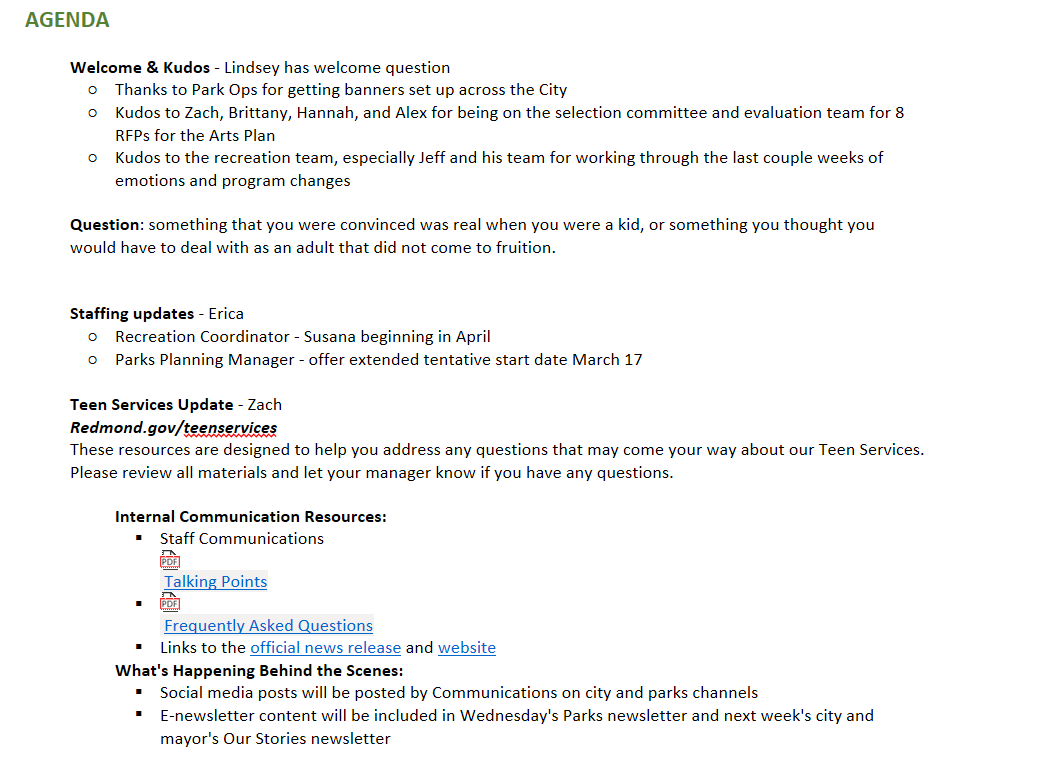
The community response was immediate. 2,104 petition signatures in the first weekend. Packed council meetings. Parents, teenagers, alumni — people who'd spent their childhoods in that building.
The city was ready for them. Template citizen responses pre-written. Staff communications pre-drafted. FAQ documents prepared. A coordinated media strategy, complete with embargoed press materials distributed to reporters the night before, with quotes pre-approved by the mayor.
Note the passive voice: "It was decided." Not "the mayor decided" or "the council voted" or "the parks department recommended." Nobody decided. It just happened.
Across 4,846 unique emails, not one identifies who made the decision to close the Old Fire House.
What the Records Don't Show
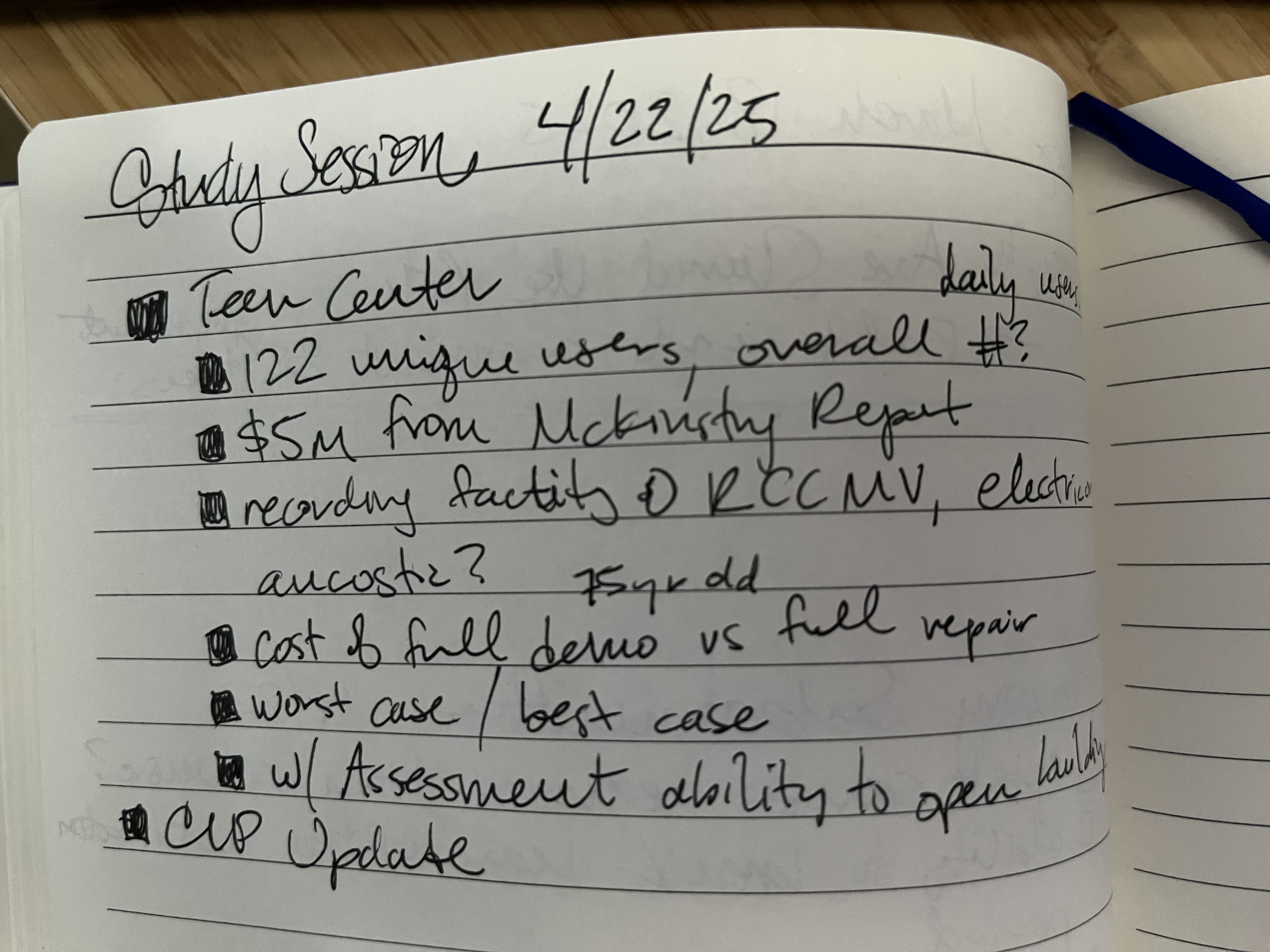
Sasha Glenn, a community advocate and KIRO 7 contributor, filed Public Records Act Request #32782 to find out how and why the teen center was being closed.
The City of Redmond responded across seven installments. After deduplication, that resolved to 4,846 unique Outlook emails.
It sounds thorough. It isn't.
Forensic analysis — running every email through duplicate detection, reply-chain analysis, and temporal mapping — reveals a production designed to look like compliance while functioning as concealment.
Produced
Zero Outgoing
Substantive Records
After Mar 30, 2025
The padding: Approximately 1,155 of 4,846 emails are exact duplicate copies by body-hash — an excess-duplication rate of about 23.8%. One email from a community member was copied 134 times. The city's own press release appears with similar redundancy across installments. At the delivery layer, one 80 MB archive (Inst_7_Jan_2024.zip) was uploaded twice to the production folder, byte-identical, MD5-matched.
The ghosts: Using reply-chain analysis — if Person A sends a reply to Person B, then Person B must have sent the original — forensic analysts identified four named City officials who produced zero outgoing records across the entire 4,846-file corpus, against substantial inbound volume. The technique is mathematically certain: the reply cannot exist without the original.
| Person | Role | Outgoing in Production | Inbound in Production |
|---|---|---|---|
| Steve Fields | Council Member (ran against Birney 2019) | 0 | ~110 |
| Osman Salahuddin | City Administrator | 0 | ~101 |
| City Council mailbox | council@redmond.gov | 0 | ~136 |
| C. Payne | City staff | 0 | ~77 |
The mayor's own outgoing record is token, not substantive: 27 emails from her personal account and 35 from the Office-of-the-Mayor mailbox over roughly twelve months — calendar invites, newsletter test drafts, press-release quote approvals, media-question forwarding. Not a single policy directive, decision email, or substantive communication on the subject matter of the records request, despite the Mayor being referenced many hundreds of times by other custodians as the decision-maker.
The attachments: The .msg files the city produced contain roughly 26,508 embedded attachment objects across 3,200 of 4,846 emails — a substantial fraction cosmetic inline signature graphics rather than substantive documents. The city produced no exemption log and no privilege log with any installment, and that procedural failure is itself a violation of RCW 42.56.210(3). Without the log, there is no way for the public to verify, on a per-email basis, whether specific substantive attachments referenced in body text — the Amendment to Transfer Option Agreement, the ALTA Title Insurance Commitment, the talking-points drafts, the embargoed press package — are present inside the containers, redacted in part, or absent.
The December 2024 collapse: The production contains only 2 unique substantive email records dated in December 2024, in a month when the city's own records confirm Stepherson & Associates PR was under a $4,468.75 monthly retainer, the Plymouth Housing Transfer Option Agreement was being finalized, and file-naming conventions in the production itself (e.g., 2024_1220_Redmond Fire House Teen Center_Interview Plan) prove substantive OFH work products were generated that month.
The March 30 cutoff: Across the full 4,846-email corpus, only 6 emails post-date March 30, 2025 — all automated notifications or non-substantive correspondence. No substantive record covers the April 27, 2025 council study session, the June 28, 2025 upzoning, the July 22, 2025 condition-assessment session, six October stakeholder-group meetings, or the November 18, 2025 demolition vote. Twelve months of active decision-making, absent from the city's response.
The Kenmore hole: The word "Kenmore" appears zero times across the full 4,846-email corpus — zero in subject lines, zero in body text — about a deal that originated from Kenmore's rejection of Plymouth Housing. Plymouth Housing appears approximately 142 times. Either every record mentioning Kenmore was withheld, or the search terms used to compile the production were constructed to exclude it.
What Happens to People Who Ask Questions
The Old Fire House isn't the first time this administration has operated this way. A pattern emerges across three incidents spanning five years.
The Suppression Playbook — Used Three Times
- Step 1: Decide in secret
- Step 2: Control the message
- Step 3: Silence the dissent
- Step 4: Destroy the evidence
March 2020: The COVID Cover-Up. Five members of fire command staff tested positive for COVID-19. According to City Council member Varisha Khan, employees were "ordered verbally to stay quiet." When the story leaked to KUOW, Fire Chief Tommy Smith was terminated 13 days later. He received $95,778 in severance with a non-disparagement clause — a gag order. The city hired investigator Jayne Freeman for $49,999.99 — one penny under the $50,000 threshold that would have required council approval. Freeman found "insufficient evidence." She was also tasked with identifying the whistleblower.
2024: Plymouth Housing. When community members and journalist Jonathan Choe of Fix Homelessness began reporting on the property transfer, the city banned Choe from council meetings. City Administrator Salahuddin referred to opponents as "NIMBYs" in text messages obtained by journalists.
2025: The Old Fire House. When Sasha Glenn began organizing community opposition, city staff compiled a surveillance report on her activities — documenting her presence at events, her social media posts, her public comments. The report reached the mayor's office within 13.5 hours. The city then weaponized its Code of Conduct, escalating from a warning to a suspension threat to the possibility of permanent expulsion from city facilities.
Steve Fields, the council member who moved to restore teen services, had 114 of his emails withheld from the public records production. He lost his council seat in November 2025.
The Ghost Network
Six days after Angela Birney was elected mayor, something unusual happened on Medium.
Between November 11 and November 30, 2019, at least 15 new accounts were created in a tight cluster around Keith Birney, the mayor's husband. All had zero articles. All had nearly identical follower counts. All followed each other.
A forensic crawl of the network revealed it extends far beyond 15 accounts. The full network encompasses 1,122 profiles. Of these, 825 — nearly 75% — have zero articles. They exist only to follow and be followed.
Keith Birney is not a random tech worker. He is a named inventor on two Microsoft patents:
Keith Birney — Patent Portfolio
- US Patent 7,502,773: "System and Method Facilitating Page Indexing Employing Reference Information" (2009) — web crawling and page indexing
- US Patent 7,676,553: "Incremental Web Crawler Using Chunks" (2010) — link graph construction
Both patents describe the exact technical skills needed to build a link manipulation network.
In December 2023, an account called @json.knight — part of the network — posted 10 articles containing hidden backlinks to more than 46 fake persona websites. The sites are hosted on infrastructure operated by Vacares LLC, a purpose-built shell company in Austin, Texas, and MojoHost, an adult industry hosting provider in Southfield, Michigan.
Every persona site contains hidden cloaking detection code — checking the visitor's IP address, user agent, referrer, and search engine flags. This is SEO fraud infrastructure.
| Batch | Registration Dates | Domains | Pattern |
|---|---|---|---|
| Pilot | November 2016 | 1 | Operation begins |
| Batch 2 | March 1, 2018 | 4 | Same day — same buyer |
| Batch 3 | January 3–11, 2019 | 5 | 9 days — post-election burst |
| Batch 4 | October 1–7, 2020 | 5 | 7 days — same buyer |
| Batch 5 | May 23, 2021 | 1 | Latest addition |
On April 6, 2026, all 12+ persona domains were captured via live web scraping, DNS snapshots, WHOIS records, and Wayback Machine archival.
Within days, every single domain went dark. All DNS records were scrubbed. All mail server subdomains were deleted. The entire infrastructure was dismantled.
The evidence was preserved before the destruction.
Profiles
(Shell Accounts)
Domains
Live Today
The Endgame
On May 10, 2025, the Downtown Redmond light rail station opened, connecting the area to Bellevue, Seattle, and the entire regional transit network. Property values surged.
On June 28, 2025, a new zoning code took effect. The Old Fire House site was upzoned to allow buildings up to 144 feet tall with a floor area ratio of 8.0. For a parcel this size, that means 300 to 400 luxury apartments.
On November 18, 2025, the Redmond City Council voted 6-0 to demolish the Old Fire House and "rebuild."
There is no budget for the rebuild. There is no timeline. There is no design. There is no funding source. The Council voted to tear down a 73-year-old community institution and replace it with a promise.
What there is: a cleared, transit-adjacent, upzoned lot worth $5 million or more, sitting directly next to 22 acres of Nelson Legacy Group development, with no landmark protection, no public process required for disposition, and no opposition left on the council.
Nothing prevents a future council from declaring the cleared lot surplus and selling it. NLG, sitting next door with 22 acres already in play and three seats on the OneRedmond board, is the obvious buyer.
The Gap in the Law
Who investigates a mayor in Washington state?
The answer, remarkably, is: almost nobody.
| Body | Jurisdiction | The Gap |
|---|---|---|
| WA Executive Ethics Board | State employees, legislators | Cannot touch mayors. Explicitly excluded. |
| Public Disclosure Commission | Campaign finance only | Cannot investigate governance or conflicts of interest |
| City of Redmond | Local ethics (RCW 42.23) | Self-policing. The mayor's city investigates the mayor. |
| King County Prosecutor | Criminal violations | 1–2 year SOL. Clock runs before pattern is visible. |
| State Auditor | Financial audits | Can audit but cannot prosecute. Refers to prosecutors who don't act. |
Washington's system is built on the theory that transparency substitutes for a watchdog agency. The Public Records Act guarantees access because the people "do not yield their sovereignty to the agencies that serve them" and "do not give their public servants the right to decide what is good for the people to know."
What Happens Next
Three Public Records Act requests have been filed: one with the PDC, one with the City of Redmond, and one with King County. A fourth, broader request — for all mayoral communications from any account or device since January 2019 — is being filed.
The forensic evidence has been preserved: 4.6 gigabytes across approximately 23,000 files, including the original FOIA productions, seven forensic databases, the complete Medium network crawl, campaign finance data, domain infrastructure snapshots, and SHA256 hashes of every evidence file.
The penalty exposure for the city, calculated conservatively under RCW 42.56.550, ranges from $3.4 million to $68 million — based solely on the provably withheld records.
Exposure
Exposure
Preserved
Archived
The Numbers
| What They Said | What the Numbers Show |
|---|---|
| Seven installments produced | 4,846 unique emails after dedup; ~23.8% excess duplicate copies |
| "We've been very open and transparent" | Four named officials produced zero outgoing records; no exemption log produced for any installment |
| $5.5M land transfer "is always very quick" | 22 days, zero hearings, zero public comment |
| "Every voice heard" | Steve Fields: zero outgoing records in 4,846-email corpus. Sasha Glenn: surveilled. Jonathan Choe: banned. |
| "Build more affordable housing" | 310 affordable units in 6 years. Home prices doubled. |
| "Invested in public safety" | First new officers since 2007 hired in year 6 of tenure |
| 62 outgoing records from the Mayor across 12 months | Zero substantive policy or decision emails; calendar invites and quote approvals only |
| December 2024 | 2 unique substantive records during documented heavy PR / Plymouth Housing / OFH activity |
| 12 months after March 30, 2025 | 6 emails produced, all automated or non-substantive |
| The word "Kenmore" | Appears zero times across the full 4,846-email corpus |
Who Is Angela Birney?
She is a former middle school science teacher who became mayor of a city of 80,000 people. She promised transparency and delivered the most sophisticated records suppression operation forensic analysts have seen from a city this size. She promised affordable housing and delivered luxury towers for the developers who funded her campaigns. She promised integrity and sat on a board with her donors while voting them no-bid contracts. She promised every voice would be heard and surveilled the voices that spoke up.
The Old Fire House was built in 1952 by 75 volunteers who wanted to give their kids a place to go. It survived the cold war, the tech boom, two recessions, and a pandemic. It did not survive Angela Birney.
This report is based on public records obtained through the Washington Public Records Act, campaign finance data from the Washington Public Disclosure Commission, IRS 990 filings via ProPublica Nonprofit Explorer, King County property records, forensic analysis of the City of Redmond's deduplicated 4,846-email corpus (seven installments plus supplemental material) using the extract_msg 0.55.0 Outlook OLE2 parser library, and open-source network intelligence. All claims of proven withholding are supported by mathematical analysis of email reply chains under RFC 5322. All statistics can be independently verified against the preserved forensic databases. Names of public officials acting in their official capacity are used pursuant to the public interest.
The City of Redmond did not respond to questions for this report.